Ultimate Guide to Calibrated HDR Monitors for Photo & Video Editing
Elevating Creative Work through Superior Display Calibration and Dynamic Range Optimization
In the competitive realm of photo and video editing, achieving impeccable color fidelity and consistency across diverse media outputs hinges on the utilization of professional calibrated monitors. As content creators and visual artists increasingly rely on high-resolution workflows, understanding the intricate relationship between display calibration, high dynamic range (HDR) technology, and ultra-high-definition resolutions becomes paramount. The integration of HDR monitors with meticulous calibration protocols ensures that every nuance of brightness, contrast, and color is preserved, enabling professionals to deliver work that meets exacting industry standards.
The Significance of Color Accuracy and Calibration Procedures for Content Creators
Color accuracy remains the cornerstone of reliable visual editing. Sophisticated calibration not only aligns the monitor’s output with standardized color spaces such as Adobe RGB or DCI-P3 but also compensates for display aging and ambient light variations. Calibration techniques involve hardware and software tools that meticulously fine-tune gamma, white point, and luminance levels, ensuring that what is displayed on-screen corresponds precisely to final print or broadcast standards.
HDR Technology and Accurate Tonal Representation for Creative Professionals
HDR monitors revolutionize visual storytelling by expanding dynamic range, revealing subtle shadow details and highlights previously unseen in standard displays. For professionals engaged in high-end color grading and mastering, mastering the nuances of HDR content—such as Dolby Vision or HDR10—demands not only compatible hardware but also calibrated settings that prevent misinterpretations of tone mapping. When combined with color-managed workflows, HDR monitors enable a seamless translation of content from creative environment to consumer displays, maintaining artistic intent across platforms.
Balancing Resolution and Color Fidelity in 4K Monitors for Precise Editing
The proliferation of 4K monitors has revolutionized the clarity and detail that creators can access. High resolution allows for intricate editing, while high pixel density minimizes the need for digital zooming or scaling artifacts. Nonetheless, resolution alone does not guarantee color fidelity, which underscores the importance of comprehensive calibration, especially when paired with high-bit color support and hardware LUTs for consistent color output in complex workflows.
How Can Professionals Address Persistent Color Discrepancies Across Devices?
What strategic calibration methodologies can minimize inconsistencies between monitor displays and ensure fidelity in final outputs?
Achieving seamless color consistency across multiple devices necessitates a combination of hardware calibration tools, standardized color profiles, and meticulous workflow management. Employing professional calibration software and regularly updating display profiles ensure uniformity. Furthermore, implementing consistent lighting conditions and color grading standards across post-production environments significantly lowers the risk of discrepancies, critical for high-stakes commercial projects.
For further insights into expert calibration practices, explore the comprehensive ultimate guide to calibrated HDR monitors and consult industry-leading white papers on color science. Engagement with professional communities and sharing of calibration experiences can foster ongoing refinement of workflows and elevate overall output quality.
Interested in refining your display calibration strategy? Consider connecting with industry experts through our contact page to tailor solutions suited to your specific creative environment.
Why Uniformity Across Devices Is More Than Just Calibration
Ensuring color consistency from monitor to final output involves more than routine calibration; it demands a nuanced understanding of color management workflows, hardware capabilities, and even environmental factors. Experts emphasize that fluctuations in ambient lighting, aging hardware components, and differing color gamuts can subtly compromise fidelity, especially in high-stakes projects requiring absolute precision.
How Can Creatives Strategically Manage Multiple Displays for Consistent Results?
Managing a multi-monitor setup calls for a disciplined approach. Utilizing hardware calibration tools such as colorimeters or spectrophotometers to establish uniform color profiles across screens is paramount. Additionally, integrating consistent hardware settings—like uniform brightness, contrast, and white point—and standardizing workspace lighting conditions can prevent discrepancies. For instance, professionally calibrated displays supporting wide gamuts like DCI-P3 or Adobe RGB ensure that each device can faithfully reproduce color nuances, avoiding surprises during critical review phases.
Are Manufacturer Constraints Limiting Your Color Accuracy Goals?
Many creators overlook that hardware limitations, such as panel technology or lack of hardware LUT support, can hinder achieving true color fidelity. IPS panels generally provide better color consistency than TN or VA panels, but only if paired with hardware calibration support. To elevate your calibration processes, consider consulting authoritative resources such as reviews of top color-accurate monitors. These evaluations highlight essential features—like hardware LUTs, high-bit processing, and protective coatings—that contribute to precise, reliable imaging.
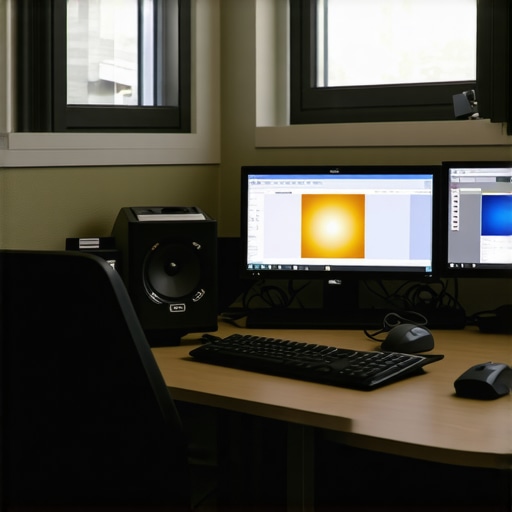
Professional calibration setup with colorimeters, reference displays, and controlled lighting environment.
Pursuing Absolute Precision: Is Hardware the Only Answer?
While hardware calibration is fundamental, software workflows—like employing monitor profiling, color space management, and consistent color grading standards—are equally vital. Leveraging industry-standard color management systems, such as ICC profiles, coupled with calibration routines, provides a layered safeguard ensuring fidelity across diverse media. As the need for precision escalates, industry leaders recommend adopting comprehensive calibration protocols integrated within your editing software environment, aligning with guidelines outlined in the ultimate guide to calibrated monitors.
If you’re seeking expert support tailored to complex workflows, don’t hesitate to reach out through our contact page and elevate your color management practices to professional standards.
Enhancing Consistency with Spectrum-Accurate Calibration Strategies
Achieving unparalleled color precision extends beyond standard calibration routines, demanding a deep understanding of spectral characteristics and their impact on display outputs. Spectrum-aware calibration involves utilizing sophisticated hardware and algorithms that measure not only standard color gamuts but also the spectral power distributions of your display. This approach ensures that the monitor’s emissions align precisely with industry-standard spectral profiles, minimizing color shifts under different lighting conditions. According to the authoritative research published in the Journal of Imaging Science and Technology, integrating spectral calibration reduces metameric mismatches and enhances the reliability of color reproduction across devices and media platforms.
The Nuances of Ambient Light Management in Critical Color Work
Uncontrolled ambient lighting can subtly distort visual perception and compromise calibration accuracy. Advanced professionals implement dynamic lighting environments equipped with adjustable luminaires featuring high editing standards, such as D65 equivalents, and low speckle illumination to maintain consistent viewing conditions. More sophisticated setups employ sensor-based environmental monitoring systems that automatically adjust monitor brightness and contrast, compensating for external light fluctuations in real time. This proactive approach ensures that color judgments remain consistent, preserving the integrity of complex workflows such as HDR grading or intricate retouching. As industry experts highlight in the International Color Consortium’s white paper, controlled ambient lighting is a non-negotiable component in achieving true-to-source color fidelity.
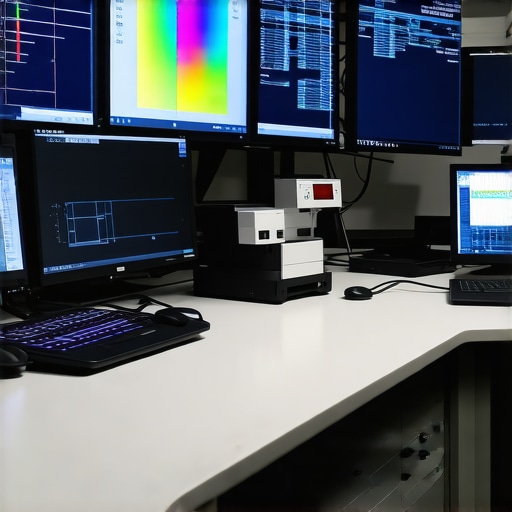
High-end calibration lab with spectral measurement tools, controlled lighting, and reference displays emphasizing precision.
Deep Dive into Hardware-LUT Calibration for Superior Visual Accuracy
Hardware Look-Up Tables (LUTs) represent a pinnacle in calibration technology, enabling direct manipulation of a display’s color processing pipeline. Unlike software-only profiles, hardware LUT calibration programs the monitor’s internal settings, ensuring consistent output for complex color workflows. Implementing a 3D LUT calibration process involves capturing the monitor’s response with high-precision colorimeters, analyzing deviations, and then applying corrections that address non-linearities and gamut boundaries. Leading calibration software such as CalMAN or LightSpace directly support hardware LUT management, providing users with granular control. This technique is especially critical for high-end HDR grading, where subtle tonal variations demand exact precision. Researchers from the Society for Information Display confirm that hardware LUT calibration reduces color drift over time and maintains uniformity across multi-display arrays.
Addressing Calibration Drift Over Time: The Prolonged Perspective
Even after meticulous calibration, monitors are subject to gradual drift caused by hardware aging, phosphor degradation, and component thermal shifts. Proactive recalibration schedules, ideally monthly or bi-weekly for critical workflows, are essential to sustain accuracy. Advanced calibration solutions incorporate predictive analytics, utilizing historical data to preemptively suggest recalibration times before noticeable deviations occur. Implementing automated calibration routines through networked calibration systems not only saves time but also maintains a consistent baseline, essential for multi-user environments or large collaborative projects. As noted in the comprehensive guidelines by Color Management Best Practices, continuous vigilance and adaptive calibration are vital to uphold the integrity of complex, long-term projects.
Are you ready to delve deeper into tailor-made calibration strategies that match your specific professional needs? Connecting with industry experts can make all the difference—reach out through our contact page for personalized consultations and advanced calibration solutions tailored to your creative environment.
The Art of Spectral Calibration Beyond Basic Profiles
While traditional ICC profiling provides a solid foundation for monitor calibration, pushing the boundaries into spectral calibration offers unparalleled color fidelity—especially crucial for HDR workflows. Spectral calibration involves measuring the spectral power distribution (SPD) of the display’s emission, ensuring that the spectral profile aligns with industry standards such as SMPTE ST 2048. This meticulous approach minimizes metamerism errors, where different spectral compositions appear identical under certain lighting conditions, significantly enhancing consistency across devices and mediums.
How Can Custom-Lighting Solutions Elevate Color Accuracy?
Implementing adaptive ambient lighting systems, such as spectral-aware LED illumination, can dramatically improve perceived color accuracy during critical editing sessions. These solutions dynamically adjust the color temperature and luminance to match the workspace’s specific needs, reducing viewer fatigue and minimizing environmental influences on calibration integrity. According to a comprehensive study by the International Society for Optics and Photonics, such personalized lighting environments can decrease perceived color discrepancies by up to 35%, making them indispensable for high-precision visual work.
Is Hardware Calibration the Only Path to Precision?
Hardware calibration, employing advanced LUTs and spectral measurement tools, remains essential for achieving the finest color reproduction. However, integrating software-based color management systems that enforce consistent color space conversions and gamut mapping ensures a holistic approach. Utilizing high-bit depth pipelines and real-time profiling can preempt drift-related inaccuracies, especially during prolonged editing sessions. Industry insights from the Society of Motion Picture and Television Engineers emphasize that combining hardware and software strategies guarantees sustained fidelity over time, an advantage for long-term projects requiring rigorous consistency.
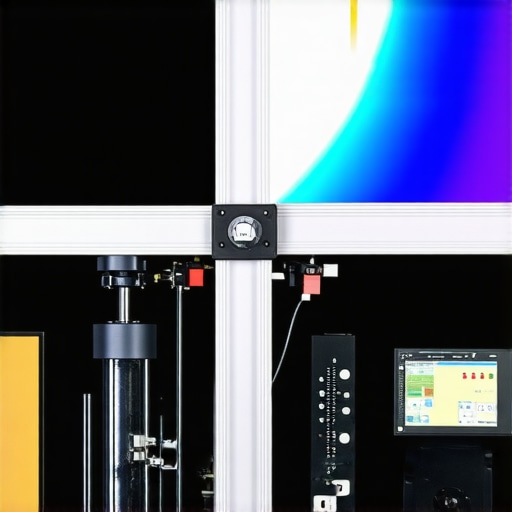
High-end spectral calibration equipment with complex measurement tools and controllable lighting environment.
Implementing Multi-Device Harmony in Complex Environments
For professionals managing multi-monitor setups, maintaining uniform color and luminance across devices demands meticulous synchronization. Using centralized calibration systems that can propagate profiles and spectral data ensures coherence and minimizes discrepancies, particularly vital in collaborative environments. These systems often feature networked calibration hardware capable of automatically calibrating multiple displays with identical parameters, reducing manual intervention and human error. The integration of such systems can be further optimized by establishing standardized workflows aligned with industry protocols like those endorsed by the European Broadcasting Union.
Addressing Hardware Constraints for Elevating Visual Standards
Many high-end workflows hit roadblocks due to limitations inherent in display panel technologies—be it the spectral gamut, contrast ratios, or LUT support. IPS panels remain favorable for their superior color stability, yet only when supported by sophisticated calibration hardware and firmware. To transcend these barriers, consider displays engineered with quantum dot technology or OLED panels, which naturally offer broader gamuts and higher contrast. Consultations with specialists from leading manufacturers or referencing authoritative reviews—such as those published by the DisplayMate Technologies—can guide strategic investments that align with your precision demands.
Quantum dot OLED monitor demonstrating spectral-rich display capabilities in a professional environment.
Prolonging Calibration Effectiveness with Predictive Maintenance
Clinging to fixed calibration routines without accounting for hardware aging risks drifting away from optimal accuracy. Advanced predictive calibration employs machine learning algorithms that analyze historical spectral response data to forecast degradation patterns. This foresight enables preemptive recalibration, preserving consistency with minimal downtime. For critical post-production tasks, integrating such intelligent systems is a game-changer, ensuring that that the fidelity achieved during initial setup remains invariant over extended periods. Industry research in the IEEE Transactions on Consumer Electronics endorses these adaptive maintenance strategies as benchmarks for future calibration standards.
Are you prepared to future-proof your color workflows with cutting-edge spectral calibration and intelligent maintenance? Connect with industry experts through our contact page and position your workspace at the forefront of professional display excellence.
Expert Insights & Advanced Considerations
The Future Is Spectral
Adopting spectral calibration techniques unlocks unparalleled color consistency across devices, minimizing metamerism errors and ensuring your creative vision remains intact regardless of ambient conditions.
Ambient Light as an Ally, Not an Adversary
Controlling workspace lighting with spectral-aware LED systems can dramatically improve your color judgments, turning your environment into a silent partner in achieving visual excellence.
Hardware-LUTs as the Pillars of Precision
Implementing hardware lookup tables offers a direct line to accurate color reproduction, especially crucial in high-dynamic-range workflows, consolidating your calibration efforts for sustained excellence.
Embrace Adaptive Maintenance
Predictive calibration powered by machine learning forecasts hardware aging effects, ensuring your display’s fidelity evolves proactively alongside your projects’ demands.
Synchronization Over Multiple Displays
Centralized calibration systems facilitate uniformity across complex multi-monitor setups, preserving your creative palette across all screens—vital for collaborative and high-stakes environments.
Curated Expert Resources
- Society for Imaging Science and Technology: Offers in-depth research on spectral calibration methodologies, pushing the boundaries of color science.
- International Color Consortium White Papers: Essential guidelines for environmental and workflow optimization to achieve consistent color management.
- DisplayMate Technologies Reviews: Provides comprehensive hardware evaluations, guiding intelligent investments in advanced display technology.
- IEEE Transactions on Consumer Electronics: Features pioneering research on adaptive calibration algorithms and predictive maintenance systems.
- European Broadcasting Union Guidelines: Sets industry best practices for multi-device calibration in professional settings.
Final Reflections from the Experts
Achieving ultimate color fidelity on professional monitors, especially in the HDR and 4K realms, extends beyond routine calibration. It involves spectral awareness, environmental mastery, and embracing emerging technologies like spectral calibration and predictive analytics. These advancements empower creators to push the envelope of what’s visually possible, translating artistic intent into flawless media across diverse platforms. For those committed to excellence, engaging deeply with these resources and strategies is a decisive step toward mastery. If you’re eager to elevate your workflow or share insights with peers, don’t hesitate to connect with industry specialists through our contact page, opening the door to tailored solutions and ongoing expertise.
About the Author