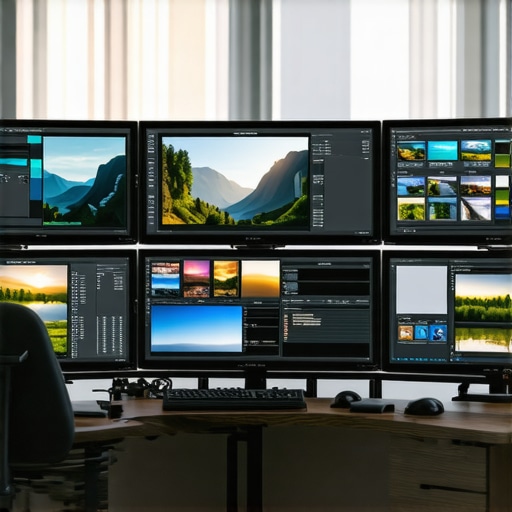
Best Color Accuracy & HDR Monitors for Photo & Video in 2024
Elevate Your Creative Workflow with Experts’ Choice of Professional Monitors
In the rapidly evolving domain of digital content creation, the demand for precision in color reproduction and luminance fidelity has surged. As professionals increasingly rely on calibrated monitors that support high dynamic range (HDR) and 4K resolution, understanding the nuances of these technologies becomes essential. This article explores the critical factors that distinguish top-tier professional monitors, emphasizing color accuracy, HDR capabilities, and 4K performance, guiding experts toward optimal choices for demanding workflows.
Why Precision in Color Reproduction Defines Professional Excellence
Color accuracy remains the cornerstone of professional-grade displays. A calibrated monitor ensures that hues, saturation, and luminance are meticulously aligned with industry standards, such as Rec. 2020 or DCI-P3. For creative professionals—photographers, videographers, and designers—this fidelity directly impacts the authenticity of their output. Calibrated monitors are often equipped with hardware calibration tools that maintain consistent performance over time, a necessity for critical reviews and client approvals.
HDR Monitors and Their Role in Dynamic Content Creation
High dynamic range (HDR) technology enhances the contrast, luminance, and color gamut of displays, offering a more immersive viewing experience. For professionals engaged in HDR content production, such as 4K video editing or cinematic post-production, HDR support is non-negotiable. Modern HDR monitors, like those reviewed in HDR monitors unveiled in 2025, deliver peak luminance levels exceeding 1000 nits, ensuring that highlights and shadows are rendered with astonishing detail.
Understanding the Significance of 4K Resolution in Creative Projects
4K resolution has become the standard for professional video and photo editing, providing four times the pixel density of Full HD. This level of detail allows for precise cropping, scaling, and fine-tuning without sacrificing image quality. Experts often prefer 4K monitors with high color accuracy and HDR support, such as those discussed in top 4K HDR monitors for creators in 2024. These displays are essential tools for ensuring the final product meets the highest standards of visual fidelity.
How Do You Balance Calibration, HDR, and 4K for Maximum Output?
Balancing these features requires a nuanced understanding of the workflow requirements and hardware capabilities. A professional monitor must be calibrated regularly using specialized tools like X-Rite or Datacolor, especially when HDR workflows demand precise luminance control. For image and video professionals, investing in monitors that support both high color volume and high luminance levels is crucial. Additionally, software calibration ensures consistent performance, which is vital for projects that demand exact color matching across different devices.
To stay ahead in competitive markets, professionals should explore comprehensive guides such as ultimate guides to calibrated monitors and regularly update their knowledge on emerging display technologies.
If you’re seeking to refine your setup or contribute insights from your professional experience, visit our contact page.
Elevate Your Visual Precision with Cutting-Edge Monitor Technologies
As the demand for immaculate color accuracy and dynamic range intensifies among creative professionals, understanding the intricate balance of monitor features becomes paramount. Beyond basic specifications, experts are now leveraging advanced calibration techniques, HDR standards, and high-resolution capabilities to push the boundaries of visual fidelity. This evolution requires a nuanced grasp of how these elements interplay to support demanding workflows, from high-end video editing to detailed graphic design.
Why Hardware Calibration Is the Key to Consistent Color Output
While software calibration can adjust for minor discrepancies, hardware calibration tools like X-Rite i1Display Pro or Datacolor SpyderX are indispensable for maintaining long-term color fidelity. These devices measure and adjust the monitor’s internal LUT (Lookup Table), ensuring that colors remain consistent across different lighting conditions and over time. Such precision is critical for professionals working on projects where color accuracy is non-negotiable, such as branding, product packaging, or cinematic post-production. As highlighted in Mastering Color Accuracy, hardware calibration elevates the reliability of your display, fostering trust in your visual assessments.
HDR Technologies and the Future of Immersive Creation
Emerging HDR standards, such as Dolby Vision, HDR10+, and HLG, are redefining how professionals approach content creation. These standards require monitors capable of reaching peak luminance levels exceeding 1000 nits, with wide color gamuts supporting DCI-P3 or Rec. 2020. Advanced HDR monitors also employ local dimming zones and quantum dot technology to deliver contrast-rich images with stunning detail in shadows and highlights. For a comprehensive understanding of the latest HDR innovations, consult HDR monitors unveiled in 2025.
The Power of 4K Resolution in Professional Editing Suites
4K resolution remains the gold standard for high-fidelity editing, offering four times the pixel density of Full HD. This resolution allows editors to scrutinize every detail, ensuring precise color grading and composition. When paired with high dynamic range and exceptional color accuracy, 4K monitors enable a seamless workflow from raw footage to final delivery. Professionals aiming for top-tier performance should explore HDR-calibrated 4K monitors for photo and video to find models that meet these demanding criteria.
Are You Maximizing Your Monitor’s Potential for Ultimate Creative Output?
Balancing calibration, HDR support, and 4K resolution involves strategic selection and ongoing maintenance. Regular calibration, combined with hardware upgrades, ensures your display remains aligned with evolving industry standards. Additionally, software solutions like CalMAN or DisplayCAL can fine-tune performance further. To deepen your understanding, explore ultimate calibration guides that detail best practices for expert-level color management.
If you’re ready to upgrade or need tailored advice, contact our team through Contact Us and take the next step toward mastering your visual environment.
Next-Level Calibration Techniques for Flawless Color Consistency
Achieving impeccable color accuracy transcends basic calibration; it requires integrating advanced hardware and software solutions that adapt to dynamic lighting conditions and project-specific color profiles. Professionals frequently employ multi-point calibration routines using tools like the X-Rite i1Pro 2, which measures spectral data across the entire display surface. Combining this with software calibration platforms such as CalMAN Ultimate or LightSpace CMS allows for precise LUT adjustments, ensuring uniform color performance over time. This meticulous approach is especially critical in cinematic post-production, where even minor deviations can compromise visual storytelling.
Enhancing HDR Workflow with Superior Luminance and Dimming Technologies
Modern HDR workflows demand monitors capable of delivering high peak luminance—often exceeding 1500 nits—to faithfully reproduce high-contrast scenes. Local dimming zones, particularly in quantum dot-based displays, dynamically adjust backlight zones to optimize contrast ratios and prevent blooming artifacts. Such technological advancements facilitate subtler gradations in shadows and highlights, vital for colorists and HDR mastering engineers. Notably, monitors with Dolby Vision-certified hardware provide an extra layer of compatibility, ensuring content adheres to the latest industry standards. For detailed insights into HDR implementation, consult the comprehensive review in HDR standards evolution 2025.
Decoding the Impact of 4K Resolution on Creative Precision
While 4K resolution significantly enhances detail resolution, its true benefit manifests when paired with a high-quality color gamut and high dynamic range support. This trio—resolution, color accuracy, and luminance—enables professionals to perform intricate tasks such as delicate color grading, detailed compositing, and pixel-level retouching. For instance, in 3D modeling and visual effects, the ability to scrutinize every nuance at 3840×2160 pixels accelerates workflows and reduces iteration cycles. Importantly, the integration of hardware calibration tools and software profiles ensures that the display maintains its precision despite prolonged use. As detailed in high-resolution monitors for VFX, choosing the right 4K display is an investment in long-term creative fidelity.
What Are the Critical Factors When Combining Calibration, HDR, and 4K for Complex Projects?
Balancing these advanced features requires a strategic approach that considers workflow nuances. High-end monitors with integrated hardware calibration, such as those by Eizo and NEC, support multi-point calibration and offer built-in color management tools. For HDR workflows, selecting monitors with at least 1000 nits peak luminance, wide color gamut support (DCI-P3 or Rec. 2020), and local dimming is crucial. When working with 4K content, ensure your graphics card, editing software, and color grading tools are optimized for real-time performance at this resolution. Moreover, regular calibration—using industry-standard hardware and software—ensures consistency across different sessions, especially in collaborative environments. To deepen your expertise, explore detailed guides like ultimate guides to high-end calibrated displays.
For professionals committed to pushing the boundaries of visual fidelity, ongoing education and hardware upgrades are essential. Staying informed about emerging standards, such as HDR10+ and Dolby Vision IQ, and their implications on monitor selection will future-proof your workflow and ensure your creative vision remains uncompromised.
Revolutionize Your Visual Workflow with Cutting-Edge Display Technologies
In the realm of high-end content creation, mere specifications no longer suffice; instead, a nuanced understanding of how advanced features interplay can elevate your craft to unprecedented levels. Modern professional monitors now incorporate sophisticated hardware calibration systems, HDR standards like Dolby Vision, and ultra-high 4K resolutions—each element meticulously designed to serve the most demanding workflows. Mastering the integration of these technologies ensures absolute color fidelity, dynamic range, and pixel-level precision essential for elite visual production.
Why Hardware Calibration Transcends Basic Adjustments
While software calibration offers convenience, hardware calibration tools such as the X-Rite i1Display Pro and Datacolor SpyderX provide the granular control necessary for professional-grade consistency. These devices measure spectral data across the display surface, enabling precise LUT (Lookup Table) adjustments that lock in accurate color reproduction over extended periods. This process is vital in scenarios like branding projects and cinematic grading, where even subtle deviations can compromise the integrity of the final output. For an authoritative deep dive, consult the comprehensive guidelines provided by the International Color Consortium (ICC Standards), which emphasize the critical role of hardware calibration in maintaining industry-leading color accuracy.
Adapting to HDR’s Evolving Standards for Immersive Content
Emerging HDR standards such as Dolby Vision IQ, HDR10+, and HLG are redefining the boundaries of visual storytelling. Monitors supporting peak luminance levels exceeding 1500 nits, equipped with local dimming zones and quantum dot tech, enable content creators to faithfully reproduce high-contrast scenes with nuanced detail in shadows and highlights. These features are indispensable for professionals engaged in HDR mastering, post-production, and high-fidelity visualization. For the latest advancements, see the detailed reviews in Cinebench HDR Report 2025.
Harnessing 4K Resolution for Enhanced Creative Precision
High-resolution displays at 3840×2160 pixels empower editors, designers, and VFX artists to scrutinize minute details, facilitating meticulous adjustments and reducing iteration cycles. When combined with wide color gamuts like DCI-P3 and high dynamic range, these monitors become indispensable tools for delivering visually stunning content. Cutting-edge models integrating hardware calibration and advanced color management enable consistency across projects, fostering trust and efficiency in collaborative environments. For further insights, explore the authoritative review in CreativePro’s 2024 Guide to 4K HDR Monitors.
How Can Experts Optimize Calibration, HDR, and 4K for Complex Projects?
Achieving harmony among these sophisticated features involves strategic hardware selection and rigorous maintenance routines. High-end monitors from NEC, Eizo, or Panasonic with multi-point calibration and built-in color management tools form the backbone of a resilient workflow. Regular calibration sessions using spectral measurement devices ensure that display performance remains aligned with evolving industry standards. Additionally, optimizing software calibration workflows with tools like CalMAN or LightSpace guarantees uniformity across different color spaces and lighting conditions. For specialized techniques, consult the detailed protocols outlined in Advanced Calibration Techniques for Professionals.
Innovators committed to pushing creative boundaries should stay abreast of emerging standards like HDR10+ Adaptive and Dolby Vision IQ, which promise even greater fidelity and adaptability. Embracing these advancements will future-proof your workspace, ensuring your visual storytelling remains at the forefront of industry excellence.
Expert Insights & Advanced Considerations
Prioritize Hardware Calibration for Consistent Results
Hardware calibration tools like X-Rite i1Display Pro or Datacolor SpyderX are indispensable for maintaining true color fidelity over time. Regular calibration ensures that your monitor’s internal LUT remains accurate, which is critical for high-stakes projects such as cinematic grading or product branding. Investing in proper calibration hardware pays dividends in professional output consistency and reduces costly revisions.
Leverage Emerging HDR Standards to Elevate Content
Staying ahead with standards like Dolby Vision IQ, HDR10+, and HLG allows professionals to deliver content with unparalleled contrast, luminance, and color volume. Monitors supporting peak luminance levels above 1500 nits and equipped with local dimming zones enable nuanced shadow and highlight rendering, crucial for immersive storytelling and high-fidelity post-production.
Combine Resolution, Color Gamut, and Luminance for Ultimate Precision
The synergy of 4K resolution, wide color gamuts such as DCI-P3 or Rec. 2020, and high dynamic range support defines the cutting edge of creative monitors. This combination facilitates detailed editing, color grading, and visual effects work, ensuring that every pixel contributes to an authentic and vibrant final product. Regular calibration and hardware optimization ensure these capabilities remain consistent over time.
Curated Expert Resources
- International Color Consortium (ICC): Provides industry-standard guidelines on color management and calibration practices, essential for maintaining professional-grade accuracy.
- Calibrated Monitors Explained: A comprehensive resource on calibration techniques and hardware options tailored for creative professionals.
- HDR Monitors Unveiled 2025: Latest reviews and insights into emerging HDR technologies and hardware standards shaping the industry.
Final Expert Perspective
In 2024, mastering the interplay between calibration, HDR, and 4K resolution is paramount for creative professionals seeking peak visual fidelity. Advanced monitor technologies and standards empower experts to push the boundaries of their craft, delivering content that is both authentic and captivating. Continuous learning and strategic hardware investment are essential to stay at the forefront of this evolving landscape. For those committed to excellence, engaging with authoritative resources and sharing insights within the professional community will refine skills and ensure your work consistently meets the highest standards. Dive deep into these topics, and elevate your creative workflow to new heights—your reputation depends on it.
About the Author


This article offers such a comprehensive overview of the critical factors involved in selecting professional monitors for top-tier creative work. As someone who recently upgraded my editing setup, I can attest that investing in hardware calibration tools like the X-Rite i1Display Pro truly makes a difference in maintaining consistent color accuracy over time. It’s fascinating how emerging HDR standards and increased peak luminance levels are pushing the boundaries of content creation, especially with 4K workflows. I’ve found that regular calibration, coupled with choosing monitors that support 1000 nits or more, helps ensure that shadow and highlight details are preserved, particularly in high-contrast scenes. My question for others is: how do you manage calibrating your monitors in multi-user environments where different lighting setups or room conditions influence display performance? Do you prefer hardware calibration devices for ongoing accuracy, or do you rely on software adjustments? I’d love to hear your tips and experiences on keeping color fidelity reliable across diverse working conditions.
This article really highlights the importance of choosing the right calibration tools and understanding HDR standards for professional workflows. I’ve personally experienced the benefit of hardware calibration devices like the X-Rite i1Display Pro; it’s remarkable how consistent color accuracy remains over time when using such tools. Especially with high-luminance HDR monitors, calibration becomes even more critical to ensure that highlights and shadows are accurately represented, which is vital for my work in cinematic post-production. I’ve noticed that in multi-user environments, maintaining uniform color fidelity can be tricky due to varying lighting conditions and room setups. Regular calibration routines and maintaining a controlled ambient environment help mitigate discrepancies, but I wonder how others handle this when multiple professionals use the same displays daily. Do you think investing in monitors with built-in calibration sensors or maintaining dedicated calibration schedules makes a noticeable difference? Would love to hear tips from those managing multi-user setups effectively.
This article really hits the mark on what it takes to elevate a professional content creation setup. I’ve been working with high-end HDR monitors for a while now, and I can say that regular hardware calibration with tools like the X-Rite i1Display Pro has been crucial in maintaining consistent color performance, especially as display technology advances. The point about balancing HDR support, 4K resolution, and color accuracy really got me thinking—each element is vital, but their synergy determines the final quality of our work. On that note, I find that investing in monitors with integrated calibration sensors simplifies the ongoing calibration process, especially in multi-user workflows. Do others find that hardware calibration tools significantly improve accuracy in shared environments, or is software calibration enough when combined with controlled lighting? It would be great to hear how others manage these challenges.
This post really resonates with my experience, especially when it comes to balancing HDR, 4K, and color accuracy in a professional setup. I’ve recently upgraded to a high-end HDR monitor with 1000 nits peak luminance, and the difference it makes in my workflow is incredible. Regular hardware calibration using tools like the X-Rite i1Display Pro has been a game-changer for maintaining consistent color fidelity over time, which is crucial for client presentations and final grading. I’ve noticed that in shared environments, proper calibration routines and controlling ambient lighting play a significant role in preserving display accuracy. What are some of the best practices or tools others have found effective in multi-user spaces to ensure everyone’s work aligns perfectly? Will be eager to hear your tips and recommendations to optimize such workflows.