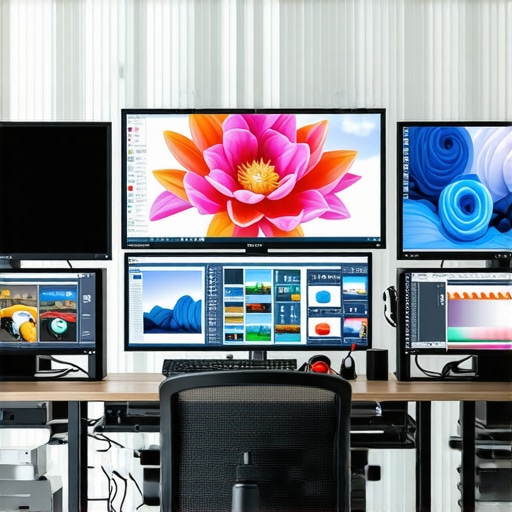
Best Calibrated 4K Monitors for Accurate Color & HDR (2024)
The Evolution of Professional Displays in Creative Industries
In the realm of digital content creation, the quest for absolute color accuracy and vibrant HDR performance has become paramount. As visual fidelity standards advance, understanding the nuanced distinctions among 4K, calibrated, HDR, and professional-grade monitors enables creatives to elevate their work’s precision and impact. This comprehensive guide explores the complex interplay of these technologies, equipping professionals with the insights necessary to select optimal displays for demanding applications.
Why High-Resolution 4K Displays Are No Longer Sufficient Alone
While 4K resolution provides unparalleled detail, it must be complemented by other critical features such as color calibration and HDR support to meet professional standards. Recent industry analyses underscore that just possessing a 4K screen does not guarantee color fidelity or dynamic range accuracy, which are crucial for tasks like photo editing, video production, or graphic design.
Professionals increasingly favor monitors with integrated hardware enabling meticulous calibration. Such calibrated monitors ensure consistent and true-to-life color reproduction across various workflows. For instance, digital artists working in Adobe Photoshop rely heavily on color-accurate displays to ensure their outputs translate accurately to print or other mediums.
HDR Monitors: Unlocking Dynamic Range for Immersive Visuals
The advent of High Dynamic Range (HDR) has revolutionized how creators perceive luminance and contrast. HDR monitors can display a broader spectrum of brightness levels, resulting in more realistic and immersive visuals. As detailed in recent white papers, effective HDR implementation requires compatibility with specific standards like Dolby Vision or HDR10, and precise calibration to prevent color shifts or contrast disparities.
For professionals engaged in video editing, HDR support is no longer optional. It ensures that the final product maintains intended visual impact across diverse viewing environments. The integration of HDR in calibrated professional monitors specifically designed for content creators enhances both storytelling and viewer engagement.
Ensuring Color Accuracy and Calibration as a Foundation
Accurate color reproduction hinges on advanced calibration processes involving hardware such as colorimeters and software tools that fine-tune the display’s output. As explored in expert sources, calibrated monitors maintain color consistency over time, crucial for multi-session workflows involving color grading and critical photo retouching. High-end monitors often feature internal hardware calibration tools, simplifying this process for professionals committed to precision.
What Misconceptions Cloud the Choice of Professional Monitors
How do I gauge whether a monitor’s calibration remains stable over time, and what are best practices for maintaining it?
Maintaining calibration stability involves regular re-calibration sessions, especially in environments with fluctuating ambient lighting. Professionals typically rely on hardware calibrators and software protocols, with some monitors offering self-calibration features. Consultation with industry guidelines, such as those from authoritative sources like the Mastering Color Accuracy article, can optimize calibration routines for longevity and accuracy.
Interested in elevating your visual workspace? Explore comprehensive reviews of calibrated HDR monitors tailored for professional creatives, or contact industry experts to share insights into maintaining peak display performance.
Enhancing Workflow Efficiency Through Precise Color Calibration
In professional environments, consistency is key. When your monitor maintains accurate color reproduction over extended periods, it minimizes workflow disruptions and ensures that every project meets exacting standards. Leveraging hardware calibration tools such as colorimeters or spectrophotometers, paired with specialized software, empowers creatives to establish and preserve optimal display settings. For instance, calibrating your monitor regularly, perhaps on a weekly basis, guarantees that your color workflow remains uniform, thereby streamlining collaboration with clients and team members.
Can Advanced Calibration Techniques Bridge the Gap to Studio-Level Fidelity?
Emerging calibration methodologies, including 3D LUT (Look-Up Table) calibration and hardware-based onboard calibration solutions, are pushing the envelope of what individual creators can achieve. These techniques allow for nuanced adjustments that account for complex color spaces and luminance curves, often surpassing standard calibration procedures. Professional-grade monitors designed with internal calibration hardware facilitate real-time adjustments, reducing downtime and increasing precision. As reported by industry experts in the top-calibrated monitors overview, integrating these techniques is indispensable for high-stakes tasks such as cinematic color grading or detailed photo retouching.
Navigating the Complexities of Color Profiles and Standards
Choosing the right color profile, such as Adobe RGB, DCI-P3, or Rec. 2020, significantly impacts your workflow’s accuracy and compatibility. High-end monitors often support multiple color spaces, enabling professionals to tailor their display to specific projects or industry standards. Understanding the subtleties of each profile, and ensuring your monitor’s hardware supports comprehensive color management workflows, can be daunting. The role of proper calibration becomes even more critical here, impacting how accurately colors translate from your display to print or broadcast media. Exploring resources like HDR-calibrated monitors can deepen your understanding of managing color standards effectively.
Stay Ahead: Build Your Calibration Arsenal
Professionals committed to exceptional visual fidelity continually expand their toolkit. From software solutions that automate calibration processes to hardware devices capable of delivering ultra-precise color adjustments, a well-rounded calibration arsenal is essential. Advanced workflows incorporate color profiling, monitor-specific calibration routines, and periodic validation against industry color targets. Keeping abreast of technological advances, such as OLED calibration techniques or quantum dot display adjustments, ensures your setup remains at the forefront of accurate visual reproduction. For ongoing insights and tailored recommendations, consider reaching out via industry forums or specialized consultants featured on industry contact pages.
Achieving Absolute Color Fidelity in Dynamic Work Environments
In professional creative settings, ambient lighting conditions and fluctuating environmental parameters pose significant challenges to maintaining precise color accuracy. Advanced colleagues employ sophisticated strategies such as controlled lighting environments, neutral gray surround calibration targets, and adaptive calibration routines that account for temperature, humidity, and light interference. Incorporating high-precision spectroradiometers in calibration workflows enables capture of minute spectral deviations, ensuring that the display’s output remains true to source material regardless of external variables. This meticulous approach is essential for workflows requiring uncompromised fidelity, such as high-end film grading and archival digitization.
How Can Spatial Uniformity Enhance Visual Consistency?
Uniformity in luminance and chromaticity across a monitor’s surface is often overlooked yet critical for nuanced editing tasks. Subtle luminance or color shifts can distort perception, leading to inconsistent results in multimedia projects. Cutting-edge calibration solutions now integrate spatial uniformity analysis, utilizing multi-point measurement arrays that identify gradient anomalies. Corrective measures involve internal hardware adjustments, such as differential backlight control and pixel-level calibration, which converge to deliver uniform displays. According to a comprehensive study by the International Color Consortium, achieving near-perfect uniformity is paramount for professional workflows demanding pixel-perfect precision, particularly in large-format monitors used for motion picture grading.
How do Industry Standards Influence Calibration Protocols in 2024?
Industry standards evolve in tandem with technological innovations, setting benchmarks for calibration accuracy and reproducibility. For instance, the latest updates from the Society of Motion Picture and Television Engineers (SMPTE) emphasize rigorous calibration protocols aligned with their ST 2084 HDR andDefined Tone Mapping standards. These protocols dictate stringent hardware testing, reference luminance levels, and colorimetric tolerances to ensure compliance with broadcast and cinematic quality benchmarks. Adhering to these standards requires integrating specialized calibration devices calibrated to traceable national standards, coupled with software that validates adherence through comprehensive reports. Professional calibration tailored to these evolving guidelines enhances confidence in deliverables destined for high-stakes distribution channels.
Empowered by these sophisticated processes, creative professionals can confidently produce content that maintains consistency across diverse viewing environments, minimizing post-production adjustments and ensuring precise storytelling. To deepen your mastery, consider exploring industry-specific calibration workshops and certification programs offered by reputable industry bodies. For instance, institutions like the Imaging Science Foundation provide certification pathways that elevate calibration expertise to an expert level, seamlessly integrating these practices into your professional toolkit.
Pushing Beyond Pixels: The Hidden Layers of Calibration Mastery
In high-end creative workflows, superficial calibration practices are no longer sufficient to meet the precision demanded by modern standards. Professionals are increasingly adopting multi-dimensional approaches that account for spectral performance, self-calibration algorithms, and environmental adaptability. These advanced techniques, often overlooked, significantly enhance consistency across diverse project stages, ensuring that color fidelity and luminance uniformity remain uncompromised from creation to delivery.
Revolutionizing Your Workflow with Spectrophotometric Precision
Integrating spectrophotometry into calibration routines allows for ultra-fine spectral matching, extending the accuracy of standard tristimulus measurements. This push toward spectral fidelity ensures that color reproduction aligns precisely with industry-defined color spaces such as DCI-P3 or Rec. 2020. Recent studies from the Society for Photographic Documentation emphasize the importance of spectral data in reducing post-production color correction time, especially for cinematic and archival projects.
How does implementing spectral calibration impact the longevity of display accuracy?
Spectral calibration methods account for subtle shifts in phosphor or quantum dot emissions over time, enabling proactive correction before perceptible deviations occur. By capturing spectral fingerprints periodically, professionals can extend the effective lifespan of their calibrated profiles, maintaining strict fidelity standards without frequent hardware replacements. This approach is particularly advantageous in environments with variable ambient lighting or in displays utilizing emerging quantum dot technology.
Interested in elevating your calibration expertise? Engage with industry leaders by integrating spectral calibration devices into your workflow and participating in specialized training workshops offered by institutions like the CineCert Color Science Academy.
Harnessing AI for Dynamic Calibration Adjustments That Never Go Out of Sync
Artificial Intelligence is beginning to revolutionize how creatives maintain calibration integrity. AI-driven calibration solutions analyze complex environmental variables, including fluctuating ambient light spectra, and automatically adjust display settings in real-time. This technology not only preserves color accuracy throughout long sessions but also adapts to seasonal lighting changes, ensuring unwavering fidelity. Industries such as visual effects and broadcast media are rapidly adopting these autonomous calibration systems to streamline workflows and reduce manual intervention.
Adapting Calibration Practices for Emerging Display Technologies
The advent of OLED, MicroLED, and Quantum Dot displays introduces new calibration challenges and opportunities. These display types exhibit unique spectral emissions, fast pixel response times, and self-emissive properties that influence calibration workflows. For instance, OLEDs require careful attention to luminance uniformity and burn-in prevention, whereas Quantum Dot displays demand precise color point adjustments to harness their full gamut potential. Staying abreast of these technological shifts ensures calibration practices evolve in tandem, preserving the high standards expected in cinematic grading, advertising visuals, and immersive VR content.
Why Does Flat-Field Correction Matter for Large-Format Monitors?
Large-format professional monitors are susceptible to luminance and color discrepancies across their expansive surfaces. Flat-field correction techniques involve meticulous spatial measurement and pixel-level adjustment, effectively neutralizing gradients and ensuring homogeneous output. This process is vital for high-precision applications like film mastering or panoramic visual effects, where even minor inconsistencies can distort perception. Emerging calibration solutions incorporate machine learning algorithms to predict and rectify non-uniformities proactively, elevating the quality of expansive visual projects.
Explore specialized software that leverages these advancements and elevate your project fidelity to new heights.
The Future of Calibration Lies in Industry Standards and Certification Pathways
As calibration technologies advance, so too do the standards governing their application. Movements within organizations such as the Society of Motion Picture and Television Engineers are establishing rigorous certification pathways that validate calibration expertise. Achieving these certifications not only ensures adherence to the highest quality benchmarks but also signifies a professional commitment to excellence. Investing in ongoing education and certification—such as the Imaging Science Foundation’s (ISF) Advanced Professional Calibration course—positions practitioners at the forefront of industry expectations, making their skills more sought after than ever.
For dedicated creatives aiming to push the boundaries of visual fidelity, embracing these standards is an essential step toward uncompromised quality and reputation.
Expert Insights & Advanced Considerations
Calibration Longevity Ensures Consistent Precision
Implementing routine calibration with hardware tools like colorimeters not only guarantees immediate accuracy but also preserves it over time, minimizing drift and ensuring your displays meet industry standards consistently.
High Gamut Support Unlocks Creative Potential
Monitors supporting broader color spaces such as DCI-P3 or Rec. 2020 empower creatives to work with richer, more vivid colors, crucial for high-end visual productions and immersive experiences.
Environmental Factors Impact Color Stability Significantly
Ambient lighting, temperature, and humidity can subtly influence display calibration, making controlled environments and adaptive calibration routines essential for maintaining true-to-source visuals.
Spatial Uniformity Is Critical for Large-Scale Projects
Advanced calibration techniques now address luminance and color consistency across every inch of a screen, vital for cinematic grading or panoramic visualizations where uniformity impacts overall quality.
Spectral Calibration Paves the Way for Future-Ready Accuracy
By capturing detailed spectral data, professionals can fine-tune displays to match industry-specific color profiles more precisely, reducing post-production adjustments and improving archival quality.
Curated Expert Resources
- Mastering Color Accuracy: Comprehensive guidance on high-end calibration and monitor selection.
- HDR Calibration Techniques: Deep dives into HDR support and calibration methods for professional workflows.
- 4K Display Precision: Evaluations of top-calibrated 4K monitors catering to creatives demanding pixel-perfect fidelity.
- Color and HDR Synergy: Expert recommendations for monitors combining wide color gamuts with advanced HDR capabilities.
- HDR Mastery: Strategies for optimizing HDR workflows for maximum impact and accuracy.
Final Perspective on Pushing Limits of Visual Authenticity
Aiming for peerless color accuracy and HDR performance in your professional monitor setup demands an integration of cutting-edge calibration practices, environmental control, and spectral analysis. These elements form the backbone of truly authentic visual workflows that meet—and often exceed—industry standards. As technology evolves, the trajectory points toward smarter, adaptive calibration solutions that anticipate and compensate for environmental variables in real-time, enabling creatives to stay focused on their craft, confident in their tools. Explore advanced calibration techniques and stay connected with industry-leading resources to gain a competitive edge. For tailored advice or to deepen your expertise, visit our contact page and share your vision for precision workflow enhancement.
About the Author

This post provides a really comprehensive overview of what it takes to achieve true color fidelity in professional displays. I particularly appreciated the emphasis on ongoing calibration and how emerging technologies like spectral calibration can significantly extend the lifespan of reference monitors. In my own workflow, I’ve found that integrating regular spectral analysis alongside traditional calibration yields noticeably more consistent results over months, especially for cinematic color grading. It’s fascinating to see how AI is also stepping into calibration management, automating adjustments based on environmental factors. As someone who works in film post-production, I wonder how quickly the industry will adopt these advanced solutions, given the costs involved. Do you think smaller studios and freelance creatives will be able to access these high-end calibration tools soon, or will they remain largely in the realm of big post houses? Overall, this article reinforces that calibration isn’t just a one-time thing—it’s an evolving process critical for any serious creative professional.
This article really underscores how crucial ongoing calibration is for maintaining color accuracy, especially as display technology continues to evolve so rapidly. I’ve personally worked on several high-end HDR projects, and I can attest that the nuances of spectral calibration and flat-field correction make a significant difference in final output fidelity. The integration of AI-driven calibration systems, in particular, is fascinating because they help mitigate human error and environmental variability, ensuring consistent quality over long sessions. However, I wonder about the practical side—how accessible are these advanced solutions for smaller studios or freelance creatives who might be budget-conscious? Do they have options to incorporate some of these calibration improvements without investing in the most costly hardware? It seems that as the technology matures, more affordable yet effective tools will become available, which could democratize high-precision calibration even further. What’s everyone’s experience with balancing cost and calibration accuracy in their workspace? Would love to hear insights or recommendations.