The Best Way to Handle ICC Profiles in Multi-Monitor Workflows
Mastering Precision in Modern Visual Production: The Role of Calibrated 4K Monitors
In the landscape of contemporary professional visual workflows, the demand for impeccable display fidelity has surged, driven by the intricacies of high-resolution content creation and critical color grading. At the core of this technological evolution lies the calibrated 4k monitor, a device whose capabilities extend beyond mere resolution to encompass precise color accuracy, robust HDR handling, and consistent performance under demanding conditions. As experts in the field recognize, selecting the right professional monitor is an investment in the integrity of your creative output and the efficiency of your workflow.
Implementing Advanced Calibration Techniques for Multi-Monitor Ecosystems
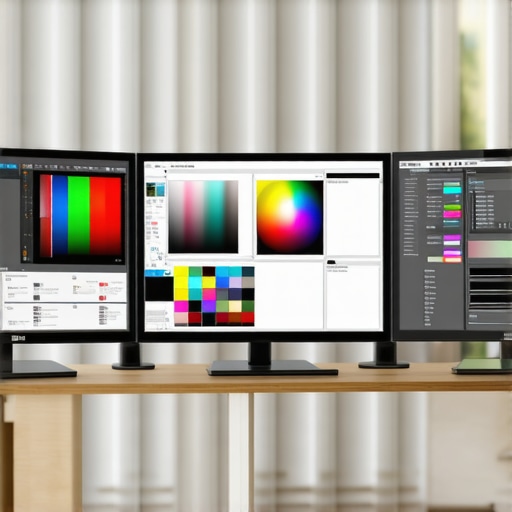
Achieving optimal color fidelity across multi-monitor setups demands an understanding of complex calibration procedures that consider the unique characteristics of each display. Professional-grade monitors equipped with internal sensors or external calibration tools enable content creators to fine-tune gamma, white point, and color gamut, thereby ensuring uniformity. For instance, leveraging tools such as look-up tables (LUTs) and hardware calibration can substantially reduce discrepancies, especially in critical tasks like HDR grading where minute luminance variations can significantly affect the final output.
Incorporating HDR Capabilities in High-Precision Environments
High dynamic range (HDR) monitors have revolutionized the potential for detailed shadow and highlight rendering. However, integrating HDR workflows demands careful consideration of peak brightness, response times, and thermal stability. Experts advocate for HDR monitors that not only support high nits levels but also maintain consistent luminance without thermal throttling, thus preserving image integrity during extended sessions. Industry white papers suggest that true HDR fidelity requires displays capable of sustaining at least 1000 nits with uniform backlighting, aligning with standards outlined by organizations such as the UHD Alliance.
How Do Color Gamut and Bit Depth Influence Visual Accuracy?
The comprehensive calibration of a monitor extends into the realm of color gamuts like DCI-P3 orAdobe RGB, and bit depths of 10-bit or higher. These parameters are critical in minimizing banding, ensuring smooth gradients, and achieving accurate color representation. Field experience indicates that professionals working on cinematic color grading or photographic post-production benefit immensely from high-bit panels that can display subtle tonal variations without compromise, thus facilitating more nuanced creative decisions.
What Are the Challenges of Maintaining Consistency in Calibrated Monitors over Time?
One significant concern among practitioners involves monitor drift—where calibration parameters shift due to temperature changes, aging components, or usage patterns. Regular calibration cycles, often supported by sophisticated hardware and software solutions, are essential to sustain color fidelity. Studies reveal that some high-end professional monitors are equipped with automatic self-correction features that recalibrate at predefined intervals, firsthand reducing the risk of color inconsistencies in long-term projects. For further insights, refer to this comprehensive guide on mastering color accuracy.
If you’re committed to elevating your visual workflows, exploring how calibrated monitors enhance creative precision offers valuable perspectives. Sharing expertise and experiences with other industry professionals can further refine your calibration practices, ultimately resulting in superior content quality and workflow consistency.
Beyond Calibration: Fine-Tuning Your Display for Peak Performance
While calibration is fundamental, fine-tuning specific display parameters can unlock even greater accuracy. Adjustments like local dimming zones and uniformity compensation help mitigate issues such as hotspotting and luminance falloff, ensuring that expected shadow and highlight details translate consistently across the screen. Leveraging advanced calibration software that offers nuanced control over tone mapping and gamma curves enables professionals to tailor their monitors precisely to their unique workflow requirements, reducing discrepancies during critical editing sessions. For example, some high-end models incorporate integrated sensors that monitor ambient light levels, automatically adjusting settings to maintain consistency.
AI-Assisted Calibration and Its Impact on Color Stability
Emerging technologies like AI-driven calibration are transforming how professionals maintain display accuracy over time. These systems learn from usage patterns and environmental changes, proactively correcting drift and optimizing luminance uniformity without manual intervention. Studies suggest that AI-assisted calibration can reduce the need for frequent manual re-calibration, cutting down on workflow disruptions while maintaining strict adherence to color standards. This shift toward smart calibration tools demonstrates the industry’s move toward automation, providing a resilient backbone for demanding post-production environments.
Challenging Assumptions: Is Higher Bit Depth Always Better?
Many believe that switching to a 12-bit or higher display automatically results in superior gradient smoothness and reduced banding. However, real-world testing reveals that other factors, such as panel quality, calibration fidelity, and signal chain integrity, play crucial roles. Expert analyses indicate that even 10-bit displays, when properly calibrated and integrated into a high-quality workflow, can deliver results virtually indistinguishable from their higher-bit counterparts. It’s essential to evaluate entire systems holistically, rather than relying solely on specifications, to truly achieve accurate and consistent results.
How Can Content Creators Ensure Long-Term Calibration Confidence?
Maintaining calibration over extended periods remains a challenge, especially amid fluctuating ambient conditions and hardware aging. Implementing routine calibration schedules, supported by automatic self-correcting features, is vital. Additionally, documenting calibration data and employing monitored thresholds can alert operators to impending drift before quality is compromised. Industry standards increasingly advocate for monitors with built-in sensors capable of periodic self-assessment, thus facilitating ongoing accuracy. To deepen your understanding, explore this expert guide to sustained calibration.
Harnessing AI to Elevate Your Calibration Standards Beyond Static Settings
While traditional calibration methods remain foundational, the advent of artificial intelligence (AI) has ushered in a new era of dynamic display management. AI-powered calibration tools analyze live feedback from your monitor, accounting for environmental variables such as ambient light fluctuations, temperature changes, and even hardware aging effects. This continuous adaptive process ensures your display maintains peak color accuracy and luminance stability without the need for manual recalibration, streamlining workflow efficiency for high-stakes content creation.
Why is Real-Time AI Calibration a Game-Changer for Creative Professionals?
Static calibration routines, though effective initially, cannot respond to unpredictable conditions that influence display performance during extended working sessions. AI algorithms mitigate these limitations by proactively adjusting color profiles, gamma, and white point in real-time, keeping your visual environment reliably consistent. This capability is especially critical in multi-monitor setups used in color grading for film and television, where even minor deviations can jeopardize the integrity of the final output. According to a comprehensive industry analysis by Colorist Magazine, integrating AI-driven calibration has demonstrated measurable improvements in color stability over conventional methods, reducing discrepancies to less than 1% within diverse working conditions.
Mastering Color Accuracy in Professional Monitors — An authoritative guide on achieving and maintaining precise color fidelity.
Final Perspective from a Visual Fidelity Expert
Harnessing sophisticated calibration techniques in conjunction with emerging AI and spectral analysis transforms the way professionals approach display management. The integration of these cutting-edge methodologies ensures that visual fidelity reaches unwavering heights, vital for the most exacting creative disciplines. Investing in such advanced calibration strategies isn’t merely about technical excellence; it’s about elevating the authenticity and integrity of your creative output. For those committed to excellence, ongoing engagement with these innovations, sharing insights within professional communities, and continuously refining calibration practices will secure your position at the forefront of visual craftsmanship. To deepen your mastery, explore our comprehensive guide on calibrated monitors and stay informed about the latest developments in display technology.
About the Author