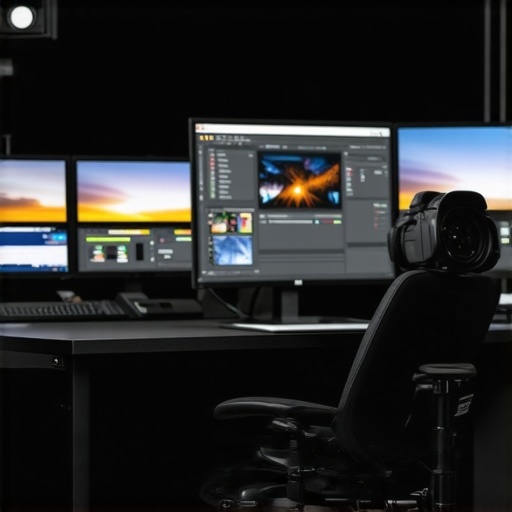
Ultimate Guide to HDR & Calibrated Monitors for Photo & Video Editing
Elevating Creative Precision with Professional Monitors
In the realm of digital content creation, the pursuit of visual perfection hinges on the deployment of high-caliber display technology. Professional monitors, distinguished by their superior color accuracy, HDR capabilities, and calibrated performance, are indispensable tools for photographers, videographers, and graphic designers committed to excellence. As industry standards evolve, understanding the nuanced differences between generic displays and professional-grade monitors becomes crucial for maintaining competitive edge and ensuring fidelity in every pixel.
The Significance of Color Accuracy and Calibration in Visual Content
Color accuracy is the bedrock upon which credible and compelling visual narratives are built. Calibrated monitors, fine-tuned through sophisticated hardware and software, ensure that the colors displayed are true to the source material, minimizing discrepancies during post-production. For creative professionals, this precision directly impacts project outcomes, from print reproduction to digital display. To achieve this, selecting a monitor with factory calibration or the ability to be custom calibrated is vital, as it guarantees consistency across editing sessions and devices.
HDR Monitors: Unlocking Dynamic Range for Vibrant Visuals
High Dynamic Range (HDR) technology enhances a monitor’s ability to display a broader spectrum of luminosity, resulting in more vivid images with richer contrast. For those involved in HDR video production or high-end photography, an HDR monitor elevates the editing experience by accurately representing brightness and shadow details. The latest HDR standards, such as Dolby Vision and HDR10+, push the boundaries of visual fidelity, making HDR monitors essential for professional-grade content creation. These displays are often paired with 4K resolution for crisp detail and are calibrated to ensure that the HDR effects are both accurate and impactful.
Why a 4K Monitor Is a Game-Changer for Creatives
The advent of 4K resolution has revolutionized professional workflows, providing unparalleled detail and clarity. A 4k monitor allows for precise cropping, detailed retouching, and seamless multi-tasking across high-resolution assets. When combined with features like wide color gamuts and high bit depth, 4K monitors become the cornerstone of a creative workspace that demands exactness. For professionals seeking a comprehensive solution, integrating a 4K, color-accurate, HDR-enabled, calibrated monitor ensures a consistent and reliable visual environment that elevates the quality of every project.
How Do You Determine the Best Professional Monitor for Your Needs?
What are the key factors that influence the choice of a professional, color-accurate HDR, calibrated 4K monitor?
Choosing the optimal display involves assessing several critical parameters: color gamut coverage (ideally DCI-P3 or AdobeRGB), factory calibration and calibration flexibility, HDR support (HDR10, Dolby Vision), resolution (preferably 4K or higher), and hardware connectivity options. Additionally, viewing angles, panel technology (IPS for color consistency), and build quality impact long-term satisfaction. For a comprehensive overview of top-tier options, explore our dedicated guide on mastering color accuracy in professional monitors.
If you seek expert advice tailored to your specific workflow, consult our contact page or contribute your insights to the community of professional creators.
For a deeper understanding of HDR and calibration techniques, consider reading authoritative resources like the white paper on HDR monitors unveiled in 2025.
Beyond Basic Calibration: Unlocking True Color Fidelity
While calibrating a monitor is essential, true color fidelity requires understanding color spaces and gamut coverage. Professionals should prioritize monitors that support wide color gamuts such as DCI-P3 and AdobeRGB, which are critical for accurate color reproduction in photography and video editing. This ensures that colors displayed during editing match final outputs, whether for print or digital platforms. For an in-depth exploration of calibration techniques and color management, visit our guide on calibrated monitors and why precision matters.
The Power of High Dynamic Range in Creative Work
HDR technology enhances visual storytelling by providing a broader luminance range, which is crucial for creating immersive images and videos. However, not all HDR implementations are equal. Choosing a monitor with support for standards like Dolby Vision or HDR10+ ensures that creators can work with the most accurate and vibrant HDR content. When paired with high bit depth and wide color gamut support, HDR monitors become indispensable for producing content that truly pops on modern displays. For a comprehensive overview, consult our HDR calibration guide for creators.
Is 8K on the Horizon or Overhyped for Creative Professionals?
As technology advances, many wonder if higher resolutions like 8K will redefine professional workflows. While 8K offers unparalleled detail, the current ecosystem of software, hardware, and content delivery has yet to fully adapt. For most creative professionals, a high-quality 4K monitor with excellent color accuracy and HDR support provides more practical benefits. Moreover, editing in 8K demands significant processing power and storage, which might outweigh the immediate gains in resolution. To explore top-rated 4K and 8K monitors suited for creative tasks, check our best 4K and 8K professional monitors.
What are your thoughts on the future of ultra-high resolutions in professional content creation? Share your insights or questions in the comments below and discover more about mastering color and resolution in our dedicated resources.
For expert advice tailored to your workflow, don’t hesitate to reach out via our contact page.
Harnessing Hardware Calibration to Achieve Absolute Color Uniformity
In advanced digital content creation, the process of hardware calibration transcends basic setup, venturing into the realm of precision engineering. Professional monitors equipped with 3D LUT (Look-Up Table) calibration capabilities allow for meticulous control over color profiles, enabling creators to fine-tune every pixel with an accuracy that rivals the original source. This process involves not only initial calibration but also ongoing adjustments to maintain consistency amid environmental changes. Implementing hardware calibration tools such as the X-Rite i1Display Pro or the Datacolor SpyderX Elite can dramatically improve color fidelity, especially when working with high-gamut standards like DCI-P3 and AdobeRGB. Moreover, understanding the implications of calibration drift and employing regular recalibration routines ensures that your workflow remains reliable over time.
The Impact of High Bit Depth and Color Gamut on Visual Fidelity
Beyond resolution and HDR, the significance of high bit depth (10-bit or higher) cannot be overstated. This feature reduces banding and posterization, which are especially noticeable in gradients and subtle tonal transitions. When paired with wide color gamuts—primarily DCI-P3 and AdobeRGB—these monitors provide a richer palette that faithfully reproduces the nuances of digital imagery. For professionals engaged in color grading or detailed retouching, the combination of high bit depth and extensive gamut coverage facilitates a more accurate visualization of final output, whether for print, digital display, or cinematic presentation. Assessing the monitor’s hardware specifications and verifying its true 10-bit support, rather than 8-bit + FRC (Frame Rate Control), is crucial for ensuring these benefits are fully realized.
How Do You Balance HDR Standards for Consistent Creative Output?
In the complex landscape of HDR standards, selecting a monitor that supports multiple formats—such as Dolby Vision, HDR10+, and HLG—can be the difference between a seamless workflow and frustrating inconsistencies. Each standard has unique metadata handling, luminance ranges, and tone mapping processes. For instance, Dolby Vision offers dynamic metadata that adjusts scene-by-scene, whereas HDR10+ provides similar flexibility but with a different mechanism. Creators working across multiple platforms must understand how these standards influence their editing pipeline, especially when preparing content for broadcast versus streaming. Achieving calibration that aligns with these standards involves not just hardware capabilities but also software tools that can accurately profile and verify HDR performance. Regular validation using test patterns and professional calibration workflows ensures that the monitor’s HDR output remains true to industry specifications, thereby maintaining artistic control and ensuring audience engagement.
Revolutionize Your Workflow with Cutting-Edge Calibration Techniques
In high-stakes digital content creation, the pursuit of impeccable color fidelity demands not only top-tier hardware but also sophisticated calibration methodologies. Professionals increasingly leverage 3D LUT (Look-Up Table) calibration tools, such as the X-Rite i1Display Pro or Datacolor SpyderX Elite, to achieve pixel-perfect accuracy. Regular recalibration routines, often integrated into automated workflows, counteract environmental fluctuations that cause calibration drift. This meticulous process ensures that every hue and shade remains consistent across projects, critical for maintaining brand integrity and artistic precision.
Unlocking the Potential of Quantum Dot and OLED Displays
Emerging technologies like quantum dot and OLED panels are redefining the standards of visual clarity and color richness. Quantum dot displays extend the color gamut, enabling coverage of DCI-P3 and Rec. 2020 standards, thereby offering vibrant, cinema-grade visuals. OLED technology, with its superior contrast ratios and near-perfect black levels, provides unparalleled depth and realism. For professionals seeking the ultimate in dynamic range and color volume, integrating these advanced panel types can elevate creative output beyond conventional LCD paradigms.
How does the integration of quantum dot technology influence the accuracy of cinematic grading workflows?
Quantum dot displays significantly expand color coverage, enabling precise reproduction of cinematic color spaces like DCI-P3. This expansion facilitates more accurate grading and color matching in post-production, reducing the need for extensive color correction. Industry standards, as documented in the SMPTE ST 2084 specifications, highlight how enhanced spectral performance directly correlates with more faithful content delivery. For insights into how quantum dot displays are transforming professional workflows, consult the comprehensive research available at the Society of Motion Picture and Television Engineers (SMPTE).
Engage with these transformative advancements to push your creative boundaries and achieve industry-leading visual fidelity.
Future-Proof Your Setup with Modular and Upgradeable Monitors
As technology evolves rapidly, the value of modular, upgradeable monitors becomes apparent. Systems that allow firmware updates, panel replacements, or calibration profile enhancements offer sustained relevance. This flexibility minimizes total cost of ownership and ensures compatibility with emerging standards like HDR10+ and Dolby Vision’s dynamic metadata. Embracing a future-proof infrastructure allows creators to adapt seamlessly, maintaining competitive edge in a landscape where visual fidelity continues to advance at a breakneck pace.
What Are the Critical Considerations for High-Precision Color Management?
Achieving true color management excellence requires attention to hardware capabilities and workflow integration. Monitors supporting wide gamuts such as AdobeRGB and DCI-P3, combined with 10-bit color depth, are essential. Additionally, the presence of hardware calibration controls, including integrated 3D LUTs, provides granular control over color profiles. Compatibility with professional color management software—like CalMAN or LightSpace—further enhances accuracy. The calibration process should include verifying the monitor’s spectral output against industry standards, ensuring visual consistency from editing to final output.
To deepen your expertise, explore the detailed guidelines provided by the International Color Consortium (ICC) on color profile management and device calibration best practices.
Maximize HDR Impact with Precision-Tuned Displays
HDR technology’s promise of richer visuals hinges on meticulous calibration and understanding of standards like Dolby Vision, HDR10+, and HLG. Advanced monitors supporting multiple HDR formats, combined with high peak luminance and wide color gamuts, enable creators to craft immersive experiences. Precise tone mapping and gamma correction ensure that HDR effects translate accurately across devices and platforms, maintaining artistic intent. Regular validation using industry-standard test patterns and calibration tools guarantees that HDR content remains vibrant and consistent throughout production and distribution.
Is 8K a Necessary Leap or a Luxurious Overreach for Creatives?
While 8K resolution offers breathtaking detail, practical considerations suggest that for most creators, high-quality 4K displays with superior color accuracy and HDR support are more beneficial. The current ecosystem, including hardware processing power, storage, and software support, favors 4K workflows. Nonetheless, early adopters and specialized fields like visual effects or ultra-high-resolution archival benefit from 8K capabilities. Evaluating your specific needs and future-proofing your setup with adaptable hardware ensures your investment remains relevant as industry standards evolve.
Stay ahead of the curve by researching the latest 8K monitor innovations and assessing their integration within your creative pipeline.
Strategic Insights for Visionary Creators
Invest in Calibration Technology to Maintain Visual Fidelity
Utilize advanced hardware calibration tools like the X-Rite i1Display Pro to ensure your monitor maintains color accuracy over time, especially critical when working with wide color gamuts such as DCI-P3 and AdobeRGB. Fixed calibration routines safeguard your workflow against environmental fluctuations and hardware drift, preserving the integrity of your creative output.
Prioritize HDR Support for Dynamic Content Creation
Choose monitors supporting multiple HDR standards like Dolby Vision and HDR10+ to achieve consistent, vibrant visuals across various platforms. Proper tone mapping and peak luminance calibration are essential for producing compelling, true-to-life images and videos that captivate audiences and meet industry standards.
Embrace 4K and Beyond for Detail-Driven Workflows
Opt for high-resolution displays, ideally 4K or higher, combined with high bit depth and wide color gamut support. These features enable precise retouching, seamless cropping, and accurate color grading, elevating the quality of your projects without compromise.
Stay Future-Ready with Modular Monitor Designs
Invest in upgradeable, modular monitors that allow firmware updates and hardware replacements. This flexibility ensures your setup remains compatible with emerging standards like HDR10+ and Dolby Vision, protecting your investment and keeping your creative tools at the forefront of technology.
Implement Routine Calibration for Consistent Results
Establish a regular calibration schedule using professional software and hardware devices to counteract environmental influences. Consistency in color and luminance ensures your workflow remains reliable, fostering trust in your visual outputs across projects and clients.
Curated Resources to Deepen Your Expertise
- Society of Motion Picture and Television Engineers (SMPTE): Provides authoritative standards on color fidelity and HDR workflows.
- International Color Consortium (ICC): Offers comprehensive guidelines on color profile management and calibration best practices.
- CalMAN and LightSpace Software: Industry-leading tools for precise monitor calibration and color management.
- White Paper on HDR in 2024: Analyzes evolving HDR standards, calibration techniques, and industry adoption trends.
Elevate Your Visual Mastery
As the landscape of professional monitors evolves, integrating advanced calibration, HDR support, and high-resolution capabilities becomes essential for creators aiming for excellence. Staying informed through authoritative resources and embracing innovative hardware ensures your work remains at the pinnacle of visual fidelity. Engage with our community, share your insights, and continue pushing the boundaries of what is possible in digital content creation—your mastery begins with the right tools and knowledge.
About the Author

This comprehensive guide really highlights the importance of investing in high-quality monitors for professional visual content creation. I’ve personally transitioned to a calibrated, DCI-P3 wide gamut monitor and noticed a significant improvement in color consistency, especially when working on high-end photography and video projects. It’s interesting how hardware calibration tools like the X-Rite i1Display Pro can help maintain accuracy over time, even with environmental shifts. I’m curious, for those who have integrated OLED or quantum dot displays, how has your experience affected your workflow, particularly in color grading? Are there specific challenges or advantages you’ve encountered? I believe keeping an eye on future upgrades—like modular monitors—can be a real game-changer for long-term workflows. Would love to hear more insights or tips from seasoned professionals on managing calibration drifts with these advanced display technologies. This post really emphasizes how critical the right gear is for achieving true artistic expression and precision.