Ultimate Guide to Calibrated HDR Monitors for Photo & Video Editing
Enhancing Visual Fidelity: The Critical Role of Professional 4K Monitors in Creative Workflows
In the realm of high-end photo and video editing, the choice of a calibrated, HDR-capable 4K monitor fundamentally influences the quality and authenticity of artistic outputs. As the technology landscape evolves, discerning professionals seek displays that not only resolve ultra-high-definition content but also deliver impeccable color precision and luminance control, elevating their work to new standards of excellence.
Deciphering the Nuances of Color Accuracy in Professional Monitors
The essence of a professional-grade monitor lies in its capacity to produce consistent, reproducible colors that faithfully represent original captures. Achieving this involves a blend of hardware specifications—like high-bit depth panels, wide color gamuts (e.g., DCI-P3, Adobe RGB)—and meticulous calibration. Expert reviews underscore that calibrated monitors ensure color fidelity surpassing basic consumer displays, which is vital for color grading and print accuracy.
The HDR Advantage: Why High Dynamic Range Matters for Photographers and Videographers
HDR support significantly expands the tonal range, enabling professionals to work with a spectrum that mirrors real-world lighting conditions. Monitors equipped with HDR10 or Dolby Vision support present richer details in dark shadows and bright highlights, essential for assessing high-contrast scenes. As per industry insights, mastering a calibrated HDR monitor can drastically improve post-production workflows, especially when delivering content for HDR-enabled platforms.
Balancing Calibration Precision and Workflow Efficiency in 4K Displays
While technical specifications are pivotal, the real-world benefits stem from rigorous calibration processes that ensure display accuracy over time. Professional-grade calibration tools and software facilitate this, enabling consistent performance and the elimination of color shifts or luminance drift. The importance of regular calibration cannot be overstated, as it maintains trustworthiness in color workflows, particularly in environments where multiple displays are involved.
Is Your Workflow Ready for the Next Level of Visual Precision?
For creators committed to excellence, selecting a monitor that harmonizes 4K resolution, advanced color management, and HDR capabilities is a strategic decision impacting overall output quality. Exploring dedicated resources such as comprehensive guides can shed light on the latest models and calibration strategies to elevate your creative process.
What are the engineering challenges in developing monitors capable of simultaneously delivering peak HDR performance and precise color calibration?
This question highlights the complex interplay between hardware components like backlight technology, panel uniformity, and LUT calibration software. Innovations such as quantum dot illumination and hardware LUTs have begun addressing these challenges, yet industry debates persist on optimizing cost versus performance. For further reading, refer to recent publications in Display Week journals focused on display engineering advances.
Engage with our community of experts and share your experiences on calibrated HDR monitors for professional editing by visiting our contact page.
How Precision Calibration Transforms Creative Outcomes
Achieving flawless color grading demands more than just a high-resolution display; it requires meticulous calibration that aligns hardware performance with industry standards. Calibrated HDR 4K monitors enable professionals to fine-tune color and luminance with exceptional accuracy, ensuring consistency across different viewing environments. Techniques such as hardware LUT calibration—supported by advanced calibration tools—are essential in minimizing color shifts and achieving uniform performance. For creatives working in film, photography, or design, mastering calibration processes directly influences the fidelity of final outputs, making it a vital skill in the digital era.
The Impact of Hardware Innovations on Color Fidelity and HDR Performance
Recent advancements such as quantum dot backlit technology and high-bit depth panels have revolutionized the monitor landscape. Quantum dot technology enhances color brightness and purity, supporting wider color gamuts like DCI-P3 and Adobe RGB, which are critical for professional workflows. Similarly, hardware LUTs embedded within high-end monitors facilitate real-time calibration and precise color adjustments, reducing dependence on external software. According to industry analyses in expert reviews, these innovations significantly narrow the gap between consumer-grade displays and professional-level fidelity, empowering creators with more reliable tools.
Why Consistent Calibration Is Your Hidden Superpower
Even the most advanced monitor cannot maintain color accuracy indefinitely without regular calibration. As luminance and color output drift over time due to component aging, scheduled calibration sessions ensure ongoing precision. Utilizing software like CalMAN or DisplayCAL, combined with hardware probes, helps detect and correct deviations, preserving the integrity of your creative process. Establishing a routine maintenance schedule for calibration becomes a strategic advantage, preventing costly rework and ensuring that your visual content consistently meets the highest standards.
Are Your Creative Projects Ready for Prime-Time Color Accuracy?
Choosing the right calibrated HDR 4K monitor is crucial for delivering professional-grade content. By investing in monitors equipped with wide color gamuts, hardware calibration support, and HDR capabilities, creators position themselves for success in competitive markets. To learn about the best tools and practices, explore our comprehensive calibration guides and stay updated on industry-leading models. Remember, mastering calibration isn’t just a technical task—it’s a cornerstone of creative excellence.
What are the key trade-offs designers face when balancing HDR performance with calibration stability?
This question underscores the challenges in hardware design, where innovations like local dimming and high dynamic range processing may introduce calibration complexities, such as uneven luminance or color inconsistency. Engineers often grapple with optimizing backlight uniformity without compromising HDR intensity, necessitating sophisticated calibration algorithms and hardware trade-offs. Insights into these engineering dilemmas can be found in recent publications in Display Week journals, which analyze how industry leaders are resolving these competing demands to produce displays that satisfy both visual fidelity and calibration stability.
Join the conversation with fellow professionals and share your experiences with HDR calibration by visiting our contact page.
,
Leveraging Software and Hardware Synergy for Flawless Color Consistency
Achieving impeccable color fidelity in professional workflows requires a harmonious blend of sophisticated hardware and precise software calibration tools. While hardware components like LUT (Look-Up Table) calibration hardware dramatically enhance real-time correction capabilities, software solutions such as CalMAN and DisplayCAL provide the interface and analytical power to fine-tune displays meticulously. Integrating these technologies enables visual creators to establish a baseline calibration that remains consistent over time, especially critical in multi-display environments where color uniformity is paramount.
How do hardware LUTs revolutionize live color correction processes?
Hardware LUTs serve as embedded lookup tables within the monitor’s internal processing engine, allowing instant application of color transformations with minimal latency. This integration enables real-time adjustments that are more accurate and stable than software-based calibration alone, especially under varying ambient lighting conditions. Moreover, hardware LUTs facilitate greater precision in matching a monitor’s output to industry color standards, such as DCI-P3 or Adobe RGB, elevating the fidelity of high-stakes projects like cinematic color grading or high-end photography. Industry experts, including those published in SID Display Week proceedings, underscore that hardware LUT calibration reduces cumulative errors and ensures enduring color accuracy—crucial for demanding creative workflows.
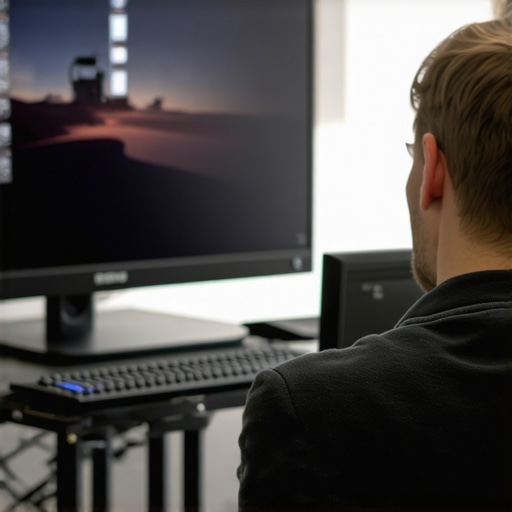
Addressing Challenges in Maintaining Calibration Stability Over Time
While initial calibration sets a high standard of color fidelity, shifts in luminance and hue can occur over days or months due to hardware aging, environmental factors, and usage patterns. Scheduled recalibrations using probe-based tools become essential to sustain accuracy. Implementing calibration routines at established intervals not only preserves the visual integrity of creative projects but also prevents costly rework associated with unnoticed deviations. Educating teams on the importance of regular calibration routines creates organizational resilience and ensures continuity of high-quality output.
What is the impact of ambient light and viewing environment on calibration longevity?
Ambient lighting conditions can significantly influence perceived and actual display performance. Bright or fluctuating lighting introduces glare and reflections, which may mask subtle calibration errors or cause users to seek adjustments not aligned with industry standards. A controlled environment with consistent, diffuse lighting minimizes these effects, allowing calibration results to remain stable longer. Additionally, integrating light sensors that automatically adapt display settings can compensate for environmental changes in real-time, maintaining optimal color and luminance levels. Research in IEEE Transactions on Consumer Electronics highlights how ambient-aware calibration tools are becoming vital in high-precision creative settings.
Engagement with calibration experts and participation in industry workshops enhances understanding of emerging solutions, making it easier for professionals to keep their monitors performing at peak levels amid evolving project demands.
Design Innovations Pushing the Boundaries of HDR and Calibration Cohesion
Recent technological frontiers, including quantum dot LED backlights and dual-layer LCD panels, are pushing the envelope in delivering both superior HDR performance and calibration stability. Quantum dots precisely emit specific wavelengths, supporting broader color gamuts and higher brightness levels without sacrificing uniformity. Meanwhile, dual-layer panels separate luminance control from color rendering, reducing the risk of color shifts during HDR content playback or adjustment. These advancements are backed by empirical studies in Society for Information Display (SID) journals, which reveal a promising trajectory toward displays that inherently preserve calibration accuracy while delivering extraordinary HDR visual quality.
Can future display technologies reconcile the trade-offs between peak HDR performance and calibration longevity?
This question addresses the ongoing challenge of optimizing backlight mechanisms, panel uniformity, and real-time calibration algorithms to support both goals simultaneously. Innovations such as microLED technology and adaptive calibration algorithms are being explored to bridge this gap, promising displays capable of sustaining high HDR luminance and color accuracy over extended periods. Experts anticipate that the convergence of nanotechnology, AI-driven calibration, and improved panel manufacturing will fundamentally reshape the landscape of professional-grade displays, offering solutions that were previously deemed mutually exclusive. To stay at the forefront, creative professionals must engage with emerging industry research and pilot cutting-edge tools as they become commercially viable.
Join our community of visual professionals to discuss the implications of these innovations and share your experiences with next-generation calibration workflows by visiting our contact page.
,
Advanced Techniques for Ensuring Long-Term Calibration Stability
Maintaining impeccable color accuracy over extended periods necessitates a thorough understanding of the internal components and their aging characteristics. Implementation of hardware-based calibration solutions, such as 3D Look-Up Tables (LUTs) embedded directly into monitor firmware, can substantially reduce drift and streamline ongoing calibration routines. Incorporating environmental controls—like temperature stabilization—further prolongs calibration integrity. This holistic approach, combining cutting-edge calibration hardware with meticulous environmental management, elevates the reliability of professional displays. For further insights, consult technical guidelines from The Society for Information Display which delve into hardware calibration innovations.
Revolutionizing Color Gamut Support with Emerging Technologies
Emerging display technologies aim to extend the boundaries of color reproduction, enabling professionals to work with unprecedented fidelity. Quantum dot enhancements, holographic backplanes, and meta-materials are contributing to wider gamuts like Rec. 2020, surpassing traditional DCI-P3 and Adobe RGB standards. These advancements facilitate an intricate palette, critical for high-end cinematic grading and immersive design work. However, harnessing these capabilities requires calibration frameworks that can handle complex color spaces efficiently. Cutting-edge color management systems are evolving to meet these demands, as detailed in recent publications from Nature Photonics.
Can AI-driven calibration adapt to display aging and environmental fluctuations in real-time?
This question underscores the potential of integrating artificial intelligence into calibration workflows. AI algorithms can analyze minute deviations caused by hardware aging or ambient light variations, adjusting color profiles dynamically. Such systems promise to reduce manual intervention and ensure sustained fidelity, especially vital in multi-monitor setups. Recent research in IEEE Transactions on Consumer Electronics indicates promising developments toward adaptive calibration, which could revolutionize professional display management in the near future.
Engage with our expert community to explore how AI-powered calibration can transform your creative workspace by visiting our contact page.
Breaking Boundaries with Display Engineering Innovation
Innovations like micro-LED technology and dual-layer LCD panels are reshaping the landscape of high-performance monitors. Micro-LEDs offer higher luminance, lower power consumption, and exceptional longevity, directly translating to superior HDR and calibration stability. Dual-layer panels enable separate control over luminance and spectral output, minimizing non-uniformities during HDR playback. These technological strides are supported by empirical findings published in SID Display Week proceedings, highlighting their potential to address longstanding challenges in professional display engineering. Such advancements promise not only enhanced visual fidelity but also improved calibration repeatability under diverse working conditions.
What role does nanotechnology play in future HDR display resolution and calibration?
This question hints at the transformative potential of nanomaterials, which can precisely manipulate light at the molecular level. Innovations like quantum dot nanostructures and nano-patterned backlights enable finer control over spectral emission and luminance uniformity. These developments suggest a future where displays inherently maintain calibration standards through advanced material properties, reducing the reliance on post-production calibration. Insights from ongoing research in Society for Information Display (SID) journals shed light on the exciting trajectory of nanotechnology in overcoming current limitations.
Join industry pioneers pushing the boundaries of display technology by participating in our upcoming webinar series and sharing your insights on next-generation calibration solutions via our contact page.
Expert Insights & Advanced Considerations
Invest in hardware calibration tools to prevent cumulative color drift over time, ensuring consistent accuracy in demanding workflows.
High-end creative environments benefit significantly from hardware LUTs and optical sensors that facilitate ongoing, precise calibration, reducing the need for manual adjustments and minimizing errors.
Emphasize the significance of ambient light control within editing spaces to uphold calibration fidelity and reduce perceived color shifts.
Professional studios integrating ambient lighting management can preserve display performance, thereby maintaining the integrity of color grading and post-production work under varying conditions.
Stay abreast of emerging display technologies like micro-LED and quantum dot enhancements, which promise to redefine the landscape of HDR performance and color stability.
Adopting these innovations early can provide a competitive edge, ensuring workflows remain at the forefront of technological advancements in display fidelity.
Curated Expert Resources
- Society for Information Display (SID): A premier source for the latest research on display materials, calibration methodologies, and technological breakthroughs in monitor engineering.
- Display Week Conference Proceedings: An annual collection of peer-reviewed papers discussing innovations in HDR, color accuracy, and hardware calibration solutions.
- CalMAN and DisplayCAL Official Sites: Leading calibration software tools offering professional-grade features tailored for accurate color management in high-definition displays.
- Industry publications like Display Daily: In-depth analysis and trend reports on monitor technology, calibration practices, and HDR advancements.
Final Perspective from a Visual Technology Expert
In the realm of professional color management, mastering the synergy between hardware calibration hardware and sophisticated software remains paramount. Recognizing the nuanced interplay between emerging display technologies and calibration stability offers a strategic advantage for creators seeking uncompromised accuracy. As visual fidelity continuously evolves, proactive engagement with authoritative resources and precision techniques will define the leaders in the field of calibrated 4K monitors. We invite industry professionals to share insights, pose questions, and explore innovative calibration strategies—join the conversation to push the boundaries of what high-end displays can achieve in your creative pursuits.
About the Author