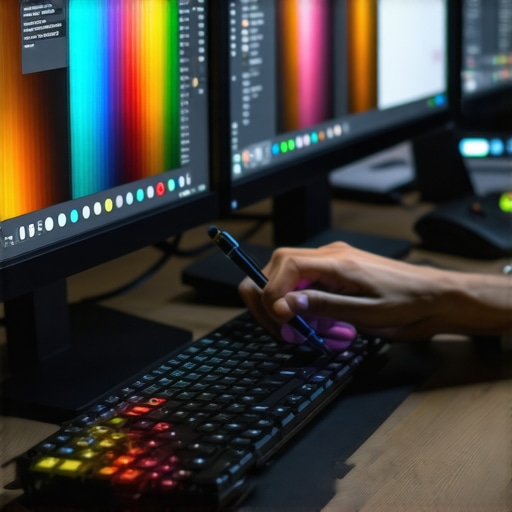
Top HDR Monitors with Precise Color for Creative Professionals 2024
The Evolution of 4K Monitors in Professional Creative Environments
In the realm of high-end visual production, the advent of 4K resolution has revolutionized how professionals approach editing, graphic design, and digital content creation. A critical consideration within this paradigm is the monitor’s ability to deliver stunning color fidelity and accurate HDR rendering, which directly impacts the authenticity and quality of creative outputs.
Unpacking Color Accuracy in the Modern 4K Display
A 4k monitor optimized for creative workflows must demonstrate exceptional color precision. This entails a wide color gamut, such as DCI-P3 or Adobe RGB, along with low Delta E values (< 2), ensuring the displayed hues are true to source material. Professional-grade displays employ hardware calibration and factory profiling to maintain this accuracy over time, aligning with standards outlined by organizations like the International Color Consortium (ICC).
The Complexity of Calibrated Monitors and Their Role in Creative Precision
Calibration extends beyond initial setup, demanding regular adjustments to account for display aging and ambient lighting changes. Calibrated monitors rely on external colorimeters or spectrophotometers, coupled with sophisticated calibration software, to deliver consistent, repeatable results essential for workflows requiring precise color matching. For instance, photographers and video editors often consult specialized guides such as this comprehensive calibration guide to optimize their display systems.
HDR Monitoring: Enhancing Dynamic Range for Creative Impact
High Dynamic Range (HDR) enhances contrast and color depth, resulting in more immersive visuals. Top-tier HDR monitors support standards like Dolby Vision, HDR10+, and HLG, with high peak brightness (often exceeding 1000 nits) and advanced local dimming capabilities. These features enable creators to accurately evaluate their projects in environments with challenging lighting conditions, bridging the gap between display and target output environments.
Addressing the Challenge of Color Consistency Across Devices
In professional contexts, maintaining color consistency across multiple devices is paramount. This involves implementing color management workflows, utilizing color profiles and calibration hardware, and adhering to industry standards such as Rec. 709 for HD content or DCI-P3 for digital cinema delivery. External sources like expert reviews provide insights into the latest equipment that ensures such consistency.
Future-Proofing with Advanced Display Technologies
Emerging technologies like quantum dot displays and OLED panels offer superior color volumes and contrast ratios, addressing long-standing limitations of traditional LCDs. As HDR standards evolve, understanding how to leverage these advancements becomes vital for professionals seeking sustainable investment in their visual infrastructure.
How Do Different Calibration Techniques Influence Final Output in High-Precision Workflows?
Choosing the appropriate calibration method—be it hardware-based or software-driven—depends on the specific requirements of the production environment. Hardware calibration tools tend to offer greater accuracy, albeit at increased complexity and cost, whereas software solutions can suffice for less critical applications or rapid adjustments. Industry experts advocate understanding the trade-offs to optimize workflow efficiency without compromising quality. For further insights into calibration practices, consult this detailed resource.
Engaging with professional communities and contributing insights on calibration challenges can significantly refine creative processes. To deepen your expertise, explore our dedicated mastering color accuracy section.
Pushing the Boundaries of HDR for Creative Excellence
While HDR standards like Dolby Vision and HDR10+ have become industry benchmarks, true mastery lies in understanding how to leverage these technologies to their full potential. Advanced HDR monitors go beyond peak brightness; they incorporate local dimming, wide color gamuts, and high bit-depth processing to render images with astonishing depth and realism. For creative professionals, this translates into the ability to see nuances and details that are often lost on standard displays, ultimately elevating projects from good to exceptional.
Demystifying Monitors That Support Multiple Color Spaces
A common misconception is that a wide color gamut alone guarantees color accuracy. In practice, effective color management involves supporting multiple color spaces such as DCI-P3, Adobe RGB, and Rec. 2020, depending on the application’s requirements. High-end displays provide hardware LUTs (Lookup Tables) and factory calibration to ensure precise translation between these spaces, enabling seamless workflows across different media formats. When selecting a monitor for creative work, reviewing specifications such as factory calibration reports and supported color profiles becomes essential, with expert insights available at this trusted resource.
Refining Color Profiles for Consistent Artistic Expression
Achieving impeccable color consistency across varied devices and media remains one of the most intricate challenges faced by creative professionals. Manipulating color profiles—such as ICC profiles—allows artists to maintain a cohesive visual narrative, from their calibrated master display to the final print or digital delivery. This process involves complex color transformations that account for gamma correction, white point adjustments, and color space mappings, ensuring that every hue and tone aligns precisely with the original vision.
What Are the Deep Implications of Color Management Strategies in Cross-Device Production?
Implementing an effective color management workflow extends beyond hardware calibration. It requires an understanding of how different devices interpret color data. For instance, a monitor calibrated for Adobe RGB project workflow must communicate effectively with printers or video renderers adhering to Rec. 709 or DCI-P3 standards. Tools such as color management modules embedded within professional editing software—like Adobe Photoshop or DaVinci Resolve—offer dynamic profiles that, when correctly employed, substantially reduce color discrepancies. Industry standards, endorsed by organizations like the International Color Consortium, provide comprehensive frameworks that facilitate this complex interoperability.
Furthermore, leveraging color management enables complex workflows involving multiple teams and media types, thereby reducing post-production revisions and ensuring fidelity to client expectations, especially in high-stakes sectors such as cinematic grading or high-resolution printing.
Harnessing High Bit-Depth Processing to Maximize HDR and Color Precision
Transitioning from standard 8-bit to 10-bit or higher color depth significantly enhances a display’s ability to represent subtle gradations and avoid banding—an artifact that diminishes visual realism. High bit-depth processing aligns with the increased luminance and color volume that modern HDR standards demand, making it possible for displays to faithfully reproduce the full spectrum of hues and luminance levels in nuanced scenes.
But beyond hardware capabilities, this advancement relies on sophisticated signal processing pipelines and 4K media optimized for high bit-depth workflows. For example, professional editing in DaVinci Resolve or Adobe Premiere Pro unlocks the potential of 10-bit workflows, ensuring that the dynamic range and color fidelity observed on the monitor translate accurately to the final output. As HDR standards evolve, mastering high bit-depth workflows becomes vital for delivering content that meets or exceeds industry benchmarks of realism and immersion.
How Does the Integration of Quantum Dot and OLED Technologies Elevate Creative Visualization?
Emerging display technologies like quantum dot-enhanced LCDs and OLED panels continuously push the boundaries of color volume, contrast, and response times. Quantum dot displays provide wider gamut coverage—often exceeding DCI-P3—and superior color stability, which are essential attributes for color-critical applications. Conversely, OLED panels excel in achieving near-perfect black levels and infinite contrast ratios due to their self-emissive pixels, enabling filmmakers and graphic artists to evaluate images with unparalleled depth and realism.
However, these technologies introduce specific considerations—such as potential burn-in for OLEDs or color shifts under different viewing angles—that require careful workflow integration. Understanding the nuances of these displays ensures that professionals can maximize their advantages while mitigating limitations, thus maintaining high standards in creative fidelity.
Future Directions: Navigating the Expanding Spectrum of Color Gamuts and Standards
Looking ahead, the proliferation of color spaces like Rec. 2020, with its vastly expanded spectral range, presents both opportunities and technical challenges for professionals aiming for the utmost color fidelity. Current hardware often falls short of fully realizing Rec. 2020’s potential, but ongoing developments in display materials and processing algorithms are promising. These advances necessitate a proactive approach to software and hardware upgrades, integrating emerging standards into existing workflows seamlessly.
In this rapidly evolving landscape, staying ahead requires continuous education and engagement with new tools, calibration methods, and industry guidelines. Professional forums, like the Society for Information Display, regularly publish cutting-edge research that can inform your strategic investments and operational choices.
Maximize Your Creative Impact—Join Our Expert Community Today
If you’re eager to deepen your mastery of color management and upcoming display innovations, explore our dedicated resources and connect with industry veterans who share your commitment to excellence. Taking a proactive stance now ensures your work remains at the forefront of visual fidelity and client satisfaction.
Transforming Creative Workspaces with Adaptive Color Technologies
Modern professional-grade 4K monitors are increasingly integrating adaptive color solutions, such as dynamic color management systems and AI-assisted calibration, to contend with fluctuating ambient lighting conditions and device aging. These innovations ensure sustained color precision, allowing artists and editors to maintain consistency without manual recalibration, thereby streamlining high-stakes workflows.
How Do AI-Driven Calibration Tools Elevate Editing Precision?
Artificial intelligence’s role in calibration now extends beyond basic adjustments, employing machine learning algorithms to analyze color accuracy trends over time and automatically optimize display profiles. Trusted industry sources, such as the report from Professional Displays Institute, highlight how AI can reduce calibration time while improving fidelity, crucial for environments demanding relentless accuracy.
What Infrastructural Investments Are Necessary for High-Fidelity HDR Work?
Achieving seamless HDR workflows requires not only monitors supporting advanced standards like Dolby Vision IQ but also compatible GPU architectures and high bandwidth data paths—such as HDMI 2.1 or DisplayHDR 1400 connections—to handle increased data throughput. Integrating color-critical storage solutions and signal processors ensures the full spectrum of high dynamic range content can be rendered and evaluated at industry-leading standards.
Benchmarking Cross-Device Color Synchronization in Complex Pipelines
Ensuring pixel-perfect color matching across diverse hardware—be it projectors, print systems, or web displays—necessitates advanced profiling and synchronization techniques. Utilizing hardware LUTs, end-to-end color management, and standardized colour grading processes mitigates discrepancies, especially in multi-stage workflows for feature film production and high-end advertising campaigns. Reports from Cinematic Color Magazine detail best practices for achieving this harmony.
The Role of Quantum Dot and MicroLED Displays in Elevating Creative Visions
Emerging display technologies like microLED are poised to redefine the boundaries of color volume and contrast ratio, delivering immersive visuals with minimal latency. Smart integration withproprietary color algorithms enables these displays to serve as true ‘visual laboratories’ for cinematographers and digital artists, providing unparalleled insight into image reproduction. These advancements demand a deep understanding of their calibration and maintenance nuances, which are critical for professionals aiming to leverage their full potential.
How Can Future Color Standards Shift High-End Visual Production?
The ongoing development of comprehensive standards such as Rec. 2020+ and HDR10+ Evolution promises richer color representation and more versatile workflows. Staying ahead requires proactive adaptation, including firmware updates, hardware refreshes, and mastering new color grading techniques that exploit expanded gamuts. Engaging with organizations like the Society of Motion Picture and Television Engineers (SMPTE) ensures professionals are aligned with upcoming industry benchmarks.
Enhance Your Creative Precision—Join Our Expert Community Today
Deepen your mastery of advanced calibration, HDR workflows, and cutting-edge display technologies by connecting with other professionals committed to excellence. Embrace continual learning and innovation to distinguish your work in a competitive landscape, ensuring your visuals achieve maximum impact and fidelity.
,
Expert Insights & Advanced Considerations
Optimize Calibration Frequency to Maintain Precision
Regular recalibration using hardware tools like spectrophotometers ensures ongoing color accuracy, especially vital in high-stakes projects. Industry professionals recommend scheduling calibration sessions based on display usage intensity and aging, preventing drift that compromises visual fidelity.
Leverage Emerging Display Technologies for Unparalleled Quality
Innovations such as microLED and OLED panels offer superior contrast ratios and color volumes, transforming creative visualization. Embracing these advancements allows artists to push boundaries, but understanding their calibration nuances is essential for consistent results.
Implement Adaptive Lighting Strategies to Enhance Color Perception
Controlling ambient lighting conditions reduces color perception discrepancies. Employing dimmable, color-neutral lighting environments complements high-precision monitors, ensuring true-to-source evaluation during critical editing and grading sessions.
Embrace AI-Driven Calibration for Efficiency and Accuracy
Artificial intelligence integrated into calibration tools analyzes performance metrics over time, automating adjustments and delivering consistent accuracy. This proactive approach minimizes manual intervention, freeing creatives to focus on their artistry.
Curated Expert Resources
- International Color Consortium (ICC): Offers industry standards and calibration profiles that uphold color consistency across devices.
- Ultimate Guide to 4K Monitors: An in-depth resource for selecting and optimizing monitors for creative workflows.
- Mastering Color Accuracy: Essential tips and techniques for achieving and maintaining color fidelity.
- Calibrated Monitors Explained: Comprehensive overview of calibration practices targeted at professionals.
Final Perspective for Creatives
Navigating the complexities of high-performance 4K monitors for professional use requires an intricate blend of technological prowess and artistic sensibility. The advancement of calibration techniques, coupled with emerging display innovations, empowers creatives to realize their visions with unprecedented accuracy. Today’s decision-makers and artists alike must stay informed—by engaging deeply with authoritative resources and embracing innovation—to ensure their work achieves measurable excellence in an increasingly competitive landscape. Dive into our resources hub to elevate your mastery and contribute your insights to this evolving industry.
About the Author

This article really highlights how crucial it is for creative professionals to stay ahead with their monitor technology and calibration techniques. I personally had a project where inaccurate color calibration led to significant revisions late in the process, which was both time-consuming and costly. Investing in a properly calibrated, wide-gamut HDR monitor made a huge difference in my workflow, especially when matching client expectations across different media. One thing I’ve found particularly helpful is implementing regular recalibration schedules, especially when working in environments with fluctuating ambient light. Regarding the various calibration techniques discussed, has anyone here found that hardware calibration tools are worth the additional investment over software solutions, particularly for small studios or freelance work? Would love to hear how others manage this balance between cost and accuracy in real-world workflows.
This post really underscores the importance of not just having a high-quality HDR monitor but also maintaining it properly through regular calibration. I’ve experienced firsthand how even a slight drift in color accuracy can throw off entire editing projects, especially when preparing content for different display standards. Recently, I invested in a hardware calibration device, and honestly, the accuracy and consistency I’ve gained are well worth the initial cost. That said, I’d love to hear from others—do you think the added expense of hardware tools justifies their benefits for small studios or freelance professionals working within a tight budget? Or have you found that software solutions, when used diligently, can achieve similar results without breaking the bank? Also, with emerging technologies like AI-driven calibration, it will be interesting to see how workflows evolve. Do you see automation playing a bigger role in maintaining long-term color fidelity, or do you think manual calibration still holds the edge for critical work?